Monday, August 19, 2013

Point to LaPointe Open Water Swim 2013


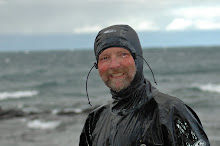
A week ago Saturday a bunch of us provided safety boat coverage for the Point to LaPointe Open Water Swim.  It seemed like a reunion of blog characters with the VOR, Gurney Granny, CleanDeckKate, GreenThumbChef, Podman, KingOfIronwoodIsland, Professor LIchen, ManFromSnowyLegs, and RangerMark all crawling out of bed at dark o'clock to make the safety meeting at 7am under the big Willow tree on Trek & Trail beach in Bayfield.  There were plenty of local folks in kayaks as well and over 400 swimmers registered with 38 safety boaters in the mix.  The weather was beautiful, cool and dry, and the lake started out placid with no wind at all.  That would change a bit by mid race as we shall see.

The start is always impressive and the sound of 400 people splashing through the water at once is some audio that can only be heard at a unique event such as this.  Swimmers are all wearing bright neon swim caps which really helps the safety folks keep track of everyone.  In the end our mission is just that, to keep track of everyone and make sure that tired, cold, or cramped up swimmers are taken care of by the power boat crews and their medical staff.  Kayakers are given zones that correspond the five large orange buoys that mark the course and we are supposed to unfold like an accordion as the lead swimmers cover the two miles to LaPointe on Madeline Island.  On the back end, the folks in charge of the sweep are making sure the last swimmer is covered and that the cordon of safety boats slowly closes up and heads for Madeline Island.  The lead swimmers cover the distance in roughly 45 minutes. The course is shut down at 10pm, two and a half hours after the start.  Forty five minutes into the swim, when the leaders were stepping out of the water was also about the time the wind and current kicked up with interesting yet predictable results. 

Those big orange buoys are tethered to the bottom, a bottom that is over 100' down in a couple of instances, by a cable and anchor.  They provide a rough guide for swimmers as they cross the channel. When the wind and current pick up they will drift.  The primary function of the kayaks is safety; the majority of time however is spent making sure the swimmers are headed for Madeline Island and not Basswood Island or Ashland.  The north to south current this year made for many Ashland bound swimmers.

I'm a lousy swimmer but a guy who can get stay afloat and get from point A to B most of the time.  I did complete the Mile Swim BSA in Boy Scouts but that was during Lyndon Johnson's administration.  Unlike we Scouts following a rowboat for a mile, alternating between crawl, backstroke, and side stroke, these swimmers were focused on one stroke and kept swimming relentlessly. Once the current started the relentless swimming continued, just not always in the direction of the finish line.  There are a number of techniques for getting folks back on course.  Most of the competitors have goggles and many also have earplugs.  Yelling does not work worth a damn.  Pounding on the side of the kayak can work but the best way to get a person's attention is to poke them with a paddle, a technique that race director Scott Armstrong refers to as being kayaked.  All are startled, some are pissed. We then explain that if they continue in their present mode they will circle back to Bayfield; we point toward the finish line, a goal that we paddlers with our eyes 30" above the water can see clearly.  About a quarter mile from the finish line, a line  marked with balloons, banners, and cheering spectators, I poked a guy and pointed to the finish line and asked him if he could see it.  "I can't see anything, my goggles are fogged up".  Hmmmmm.  Maybe take em off?  I asked another guy how he made sure he was going in a straight line.  "I just key on the splashes of the guy in front of me.  The theory of lemmings blithely jumping off a cliff had been debunked but the idea of distance swimmers following each other, perhaps in a circle is apparently alive and well.  I found that if I aimed 17' of brightly colored fiberglass at the finish line like an arrow that worked the best for the swimmers to key on.  I would then paddle alongside for awhile and that seemed to work.  Once I moved on to the next group of swimmers though, all bets were off.

I've had fun with this little story and have had fun with the race for the last several years as well.  There is no way in hell I could swim two miles, and I applaud everyones effort.  As my buddy Eric Iverson pointed out, the guy that finished dead last still beat everyone that didn’t swim, including Eric and I. For the most part the swimmers navigate the crossing without much  trouble and although the main pack tends to expand and contract in all directions things go pretty smoothly.  The main goal is to be alert for tired or cold swimmers, a mission that RangerMark fulfilled when he helped two swimmers out of the water.  There is always room for improvement though, and at 7:20am both swimmers and safety boaters can be a bit groggy and sometimes information can go in one ear and out the other.  LIke most endeavors that are worthwhile, constant improvement is the goal.  I have some kayaking contacts out in the Bay Area that have safety boated the Alcatraz swim as well as other ocean events and I hope to get some tips from them.  While we don't have a 3 knot ebb tide like they have in the bay, there are certain constants to the safety boating mission. If any readers have any good suggestions or insights, please comment or email me.  As the swim grows larger, and it has grown geometrically over the years, more experienced and organized safety boat volunteers are a necessity.  The Coast Guard has a sizable presence as do the volunteers in the Coast Guard Auxiliary and medical volunteers.  Good coordination and communication between all parties can make this an even more fun and keep this very popular event safe and efficient as it grows.  It's a great day on the water for everyone involved in this cool community event and it can only get better.


Tuesday, August 6, 2013

Taking down Giggles the Fawn


I am way behind CNN, the AP, Huffington Post, the New York Daily News, and the Daily Mail on this but I thought the Wisconsin DNR's raid on the Society of St Francis no kill animal shelter to corral and euthanize Giggles the fawn was worth a post.  Unlike the Daily Mail, I'm not approaching this on the 'Bambi tack', the anthropomorphic, isn't it cute, 'deer are people too' style of moral outrage.  Nope, what this incident illustrates is an insane over reaction and over the top use of the powers of the state to resolve a piddling incident that would have gone away on it's own the very next day.  With all the budget cuts and understaffing, including cutting 32 more DNR jobs just three months ago, an operation such as this just points out the lack of intelligent prioritization in an increasing politicized state agency.

The short story on this incident is that after receiving an anonymous tip that the St Francis animal shelter in the Kenosha area had an illegal wild animal at it's facility, a combination of aerial and ground surveillance determined that there was indeed a whitetail deer fawn at the facility, a clear violation of state law.  This evidence was presented to a judge who issued a search warrant and this is when the fun began.  A heavily armed contingent of 13 officers, nine DNR and four deputies, raided the facility and detained the staff for a couple hours.  Drawers were rifled, cell phones confiscated, and of course Giggles was located, tranquilized, tossed in a body bag that one of the officers then tossed over his shoulder, to be offed at a remote location. You can read the AP story or the  Huffington Post for more details.

Several things leap out to a person who is able to devote 60-90 seconds of thought to the problem.  Why not call the shelter and see what they have to say?  Why use aerial assets when a warden slinking along the fence actually saw the fawn, plenty of probably cause for a search warrant?  Why bother with a search warrant in the first place when a DNR agent could just stroll up to the office and say, "Hey, we have a report that you have a whitetail fawn here.  Is that true? Do you know its a violation of Wisconsin law?" Another tactic would have been to wait 24 hours and the problem would have gone away.  The fawn was scheduled to be shipped to an animal rehab shelter in Illinois the very next day, a state where possession of a wild animal is not illegal. And finally, why show up with thirteen armed agents?  It's an animal shelter for God's sake, not a Taliban stronghold.  We are in the process of adopting a new pup from the rescue shelter and none of the employees look like ex members of the Crips of Bloods and none appeared to be carrying.  They actually seemed to be mild mannered, caring people that were interested in animal welfare. 

Once this whole international shitstorm erupted, the really smart thing for the DNR to have done would have been to put out a statement saying that they had screwed up, screwed up badly, apologize, and state that they were looking at methods and policies to prevent a reoccurrence.  Instead they put out two press releases on their Facebook page that attempt to justify the raid in one of the lamest fashions imaginable.  Shortly after the second one was issued the FB page was taken down.  It has since been restored.

The Department of Natural Resources in Wisconsin has had an image problem for years, some of it deserved and much of it not.  I just received my Wisconsin Natural Resources magazine which had great articles on restoring rivers and harbors, bringing back the sturgeon, and stories on a couple of our outstanding state parks.  We have plenty of cops, how about focusing the agency on the real threats to our state?  My friend from England, a police officer, was taken aback when I pointed out that we could be pulled over by a State Trooper, county sheriff, city cop, park police, or even the tribal police. It befuddled him how they could keep the jurisdictions straight.  I am personally a hell of a lot more concerned about them hauling all the sand in Chippewa County out to the Bakken Field, GTAC leveling the Penokees, or even more closely monitoring the crap that fouled the rivers and harbors described in the WNR mag article than I am whether some animal shelter is a transit stop for a fawn. I would much rather have wardens monitoring those areas, documenting violations that actually impact the public good, than this stupid waste of resources, including court time, in Kenosha.  Heck, they even wasted Gov. Walker and all of his cabinet secretary's time when he needs to stay focused on his nationally renowned job creation efforts.  We had a conversation last week as we patched up the BadHatter, who was attacked by a rogue kayak rudder on Miner's Beach. A retired DNR professional in the group commented that he had a lot more training on how to shoot people over the years than he did on patching them up.  They hit the range far more frequently than the CPR/First Aid classes, even though he had rendered first aid to a significantly larger number of people than he had shot.  When I worked in the DA's office in Eau Claire about 40 years ago, the wardens were always the most interesting guys that came by the office.  Even though I knew a few renegade game law violators that looked askance at the wardens, the general perception was that they were there to help out.  Even my buddy, SilenceOfTheLambChop up in Minocqua, is questioning his volunteer work for the loon project since it serves the same knuckleheads that bring you wolf hunting, bear hunting with dogs, and other shaky activities.  We need to get back to that image of the DNR warden and put an end to the stupidity and incredible waste of resources that occurred in mid July down in Kenosha. Stop worrying about form and get dialed in on functional policies.  The Giggles incident did not border on the ridiculous, it was well beyond the border.

Disclaimer: That is not Giggles at the top of the post, it's a fawn that stopped and dropped on Lake O'Brien Rd one evening as I was heading to camp.  It was motionless, accepted fawn procedure when encountering potential threats, and I spotted mom about 30 yards in the woods watching anxiously. My guess is that whoever picked up the 'abandoned' fawn had a freaked out mom watching somewhere.  Leave nature alone people!  If the fawn was abandoned it would likely make a nutritious meal for a bear, coyote, or some other predator.  That's how nature works and its worked pretty well over the millennia.

Also the heavily armed gentleman in the images is not a member of the DNR or the Kenosha Sheriffs Dept. either.  It's No2 son on his all expenses paid government sponsored trip to iraq in 2004.  Just wanted to clear that up.
The frac sand image was heisted off the web and shot by Jim Tittle for Midwest Energy News

Thursday, August 1, 2013

A Spray Falls adventure


This has to be the longest stretch that this site has gone without a new post since 2007 when I started writing it.  A combination of other work related writing and an almost unprecedented thirteen days away from the desk had made me lazy and a bit preoccupied.  I'm back.  I find that being outdoors constantly dampens the urge to write while sitting in front of a computer screen doing mundane, non writing related tasks seems to fuel the urge. 

My time off was book ended by coaching at the Great Lakes Sea Kayak Symposium on the front end and being coached by Turner Wilson and Cheri Perry on the back end.  Both experiences provided excellent learning opportunities and being on both sides of the kayak learning model helps with both instructing and being instructed.  The guiding aspect of sea kayaking is one that I attempt to avoid but one that is expected of us on day one of the GLSKS.  This year I drew the Spray Falls Adventure, along with FivePieceRoy, MrEngineerGear, Marius, and Ray.  The five of us had roughly  fifteen paddlers and the tour was indeed an adventure.
The paddle began off loading boats at one of the finest mosquito preserves on the UP, the Beaver Bay campground.  This years late, wet summer has made mosquito breeding conditions absolutely perfect.  The silver lining was that it sped up the launch considerably.  The route for the tour is certainly an adventure.  It begins with a short paddle from a small bay through a channel and into Beaver Lake is. A creek leaves Beaver Lake and flows a twisty, snaky 800 meters to Lake Superior.  At the end is a log jam that requires a roughly 80 meter (16 rods for you BWCA fans) portage.  It was a bit of a character check and watching some folks help with four or five boats vs. others helping with zero boats gave a pretty good indication of what to expect on the big lake. It was a rainy day, a deluge at times, and we could hear far off thunder but had not seen any lightning flashes.  Radar on the iPhone seemed to indicate the storm was over Grand Island and moving off to the northeast, good news for us, bad news for the two Grand Island tours, one of which waited three hours to launch.  Our group paddled about a mile southwest along the shore and stopped at the end of twelve mile beach, the last landing spot before the cliffs, to evaluate the weather.  Rain but no more rumbling helped us decide to paddle the two miles to the falls.  There were nooks and crannies to play in and gulls and mergansers to entertain us, which tended to string out the group, a situation that was not a problem on water as flat as a pancake and with five coaches.  Then we saw the falls.

The same wet weather that favored the mosquito community had increased the flow of the falls to triple or quadruple its normal volume.  A paddler could normally paddle under the flow and cool off but paddling under this flow would result in an instantly snapped neck. I'm not sure what the cfs flow was but at 8#/gallon there were tons of water cascading off the cliff every second. This was bluntly pointed out to a couple of folks and everyone kept back a decent distance.  The amount of spray and velocity of the wind coming off the water column highlighted the force of the falls.  We regrouped to head back to the creek mouth and things became strung out again, bad if the lake was active but again, with five coaches spread out and keeping contact with everyone it worked OK.  After 'riding drag' as we paddled and pulled our boats back up the creek to Beaver Lake, we encountered the southwest wind in the wake of the storm that had nicked us. Our friends off Grand Island had a hell of a time getting back with with gusts up to 30mph but fortunately minimal fetch.  Some of our newer paddlers had a tough time on the inland lake but we all managed to get to the small channel to the bay in good shape.

LIke real estate values, the key to this tour was location, location, location. It was arguably the best tour choice of that stormy Thursday. One tour was called off, a couple more delayed, and the Grand Island ones offered a bit more challenge than some people had hoped for. Tow belts were indeed deployed.  We missed the lightning and were in the lee of the SW wind while on the big lake. It seemed that everyone had a great experience as evidenced by the beer fueled conversations at the annual Beers with Bill slide show.  Other than a bit of towing, all we guides had to do was paddle, chat, and keep our eyes open.  Like most of 'em, it was a good day to be on the water.

Tuesday, July 9, 2013

The Sand Island bear closure


Our 'first crossing' trip went almost perfectly for our group of 14 paddlers on the last weekend before ‘the 4th’ in the Apostle Islands.  The weather cooperated nicely with cool temps, partly cloudy skies, and a breeze that freshened at about the same rate as the paddlers skill level increased.  It was obvious we had some veteran campers and it was fun to see people become more comfortable in their boats.  A person can practice strokes and maneuvering all they want but the real test is moving forwards, backwards, and sideways in the sea caves and everyone passed that little pop quiz quite nicely. The mosquitoes were quite active but, like most things, folks got used to them with a combination of DEET and bug nets.  I also noted that mosquito discomfort was inversely  proportional to beer consumed.  A few of us even got a swim in, some (OK, me) after being politely informed, 'you stink!'.  Water on the north end of Sand was at least 15F colder than on the south end, a good reminder of why we dress for immersion on Gitchee Gumee.  We also had some nice talks with at least three rangers and the volunteer on Sand.  The overriding topic was bears.  In particular one bear that had been raiding the campsites for the past few days.  When I got home and opened my email on Monday morning, I saw that the Park Service had closed Sand Island indefinitely to overnites due to bear activity.  This brought back some deja vu from the last time our group were the last ones to use the campsite on an island.  In that case it was Manitou and the closure was for the entire season because of a bear. Then a couple days later, after the bear raided some sausages from a beached boat on Lighthouse Bay, the island was closed for all usage.

Closing Sand right before the 4th of July must have created some incredible disruptions.  Two large group sites and 4 individual sites would make for a maximum total of 48 people per night that would need to be moved. This would require some creative juggling because there just aren't that many options, although it sounds like the rangers and staff were able to pull it off.  If we consider that most of these group sites were chosen by lottery on January 8th of this yea, we can get a bit of an idea of the effect that this closure will have. Like most human interaction, some people will roll with the punches while others will be indignant and pissed off. I do not envy the park staff doing the campsite shuffle, especially when very few extra sites are available during this peak season.

Back to the bear. From what we heard last weekend it was one bear, with the theory being it was a yearling male that momma bear had kicked out on his own.  Even now food is scarce due to the late spring and this guy is exploring and trying to figure out how to survive. So far it has torn up a tent to get at some toothpaste, ripped open a kayak hatch to get at some food that some idiot decided to leave on the beach instead of sticking in a bear box, and stealthily snuck into camp and grabbed food that was left out while the campers were otherwise occupied. Plus the boat incident on the other side of the island.  In other words, campers that were lax in taking care of their consumables have conditioned this young bear that food can be had around people.  Shame on us for being stupid.  Once again irresponsible actions by a few people, whether through ignorance, sloth, or actively ignoring good camping practice, have created a major pain in the ass for the rest of the responsible campers and outfitters. So, as V.I. Lenin asked in the early part of the last century, What Is To Be Done?

The Park Service will attempt to 'train the bear to be afraid of humans'.  Those really loud airhorns (‘like’ the AINL on FB and you can watch a jerky 10 second clip of a bear being chased away from the Oak Island dock area with such a horn), fireworks, and other things to disassociate humans with food are utilized.  Closing the island to camping also automatically culls out the 5% of idiots who don't think the food rules and bear box usage applies to them.  Relocating and shooting are also no longer acceptable, although 'Scarface', the bear that closed Manitou and backed a volunteer into the outhouse a few years back, is alleged and rumored to be peering over a desk as a head mount somewhere.  The islands are open to deer and bear hunting in the fall  but the logistics are such a pain in the rear end that most people don't do it.  That and the fact that there are plenty of bears in Wisconsin elsewhere, 25,000 by last count.

It's a tough situation.  I don't remember the NPS ever closing Sand Island or for that matter, any of the other jumping off point islands, especially those with group sites.  Even though I don't have vote but if I did I'd go for relocation.  The bear is in a condition of fending for itself at this point and it might as well do its exploration and testing in a more sparsely populated area.  Our deer camp was that spot for a number of years.  Bears caught in Bayfield or Washburn were transported to the western part of the county and released.  For awhile we had lots of bears that just weren't that afraid of us, although other than breaking into our shed to steal and maybe huff some gas and biting my ATV seat a couple times as it sat in the woods, we had no real trouble. Just last week however, a bear showed up on the porch and ate some burger, mayo, and ice from a cooler that was sitting there. We may be in the same boat as the NPS with a problem bruin.  If relocated, Yogi may swim back to Sand but that could take awhile.  In the meantime both campers with long term reservations and park service employees who have to tell them they are screwed will have a much more enjoyable summer if the offending bear is elsewhere.  As I've said here before, no matter what you name it or what the Federal Government decides to designate it, it just ain't a wilderness.  Old cars, roads, a couple stone foundations, and cottages all point to the fact that it was a human settlement area years before someone decided it was part of the Gaylord Nelson Wilderness Area.  Deal with the bear.  It was there first, it lives there, it isn't it's fault, etc., etc., etc., are all valid points.  It's also a major human use point in a National Lakeshore during peak season, the start of the most visited two months in  the park. Even a yearling can be dangerous, as my friend the BearWhisperer related to me when a yearlingabout the size of a ten year old kid woke up when they were checking hibernating bears as part of a research project.  He is a well muscled 6'2" guy and told me that this bear was kicking his ass until his partner stepped in to help. Bears of any size are not to be trifled with.  If a week drags into two weeks and then a month and then it’s Labor Day, I don’t think anyone will say the cost/benefit of leaving the problem bear running around on Sand, using it as it’s own private bear preserve and spa, would come out on the positive side of the ledger sheet.